

DfMA: unlocking the full potential
changing the focus from technology to enabling early design
This insight discusses using how using early engagement of specialist manufacturing knowledge into MEP design maximises the full benefit of speed & offsite construction through repetition & standardisation.
What is DfMA?
Although often described as a ‘modern method of construction’ [1], Design for Manufacture and Assembly (DfMA) has been successfully used within the UK construction industry for more than 20 years. In the context of MEP services, DfMA is a design methodology that enables building services components and systems to be manufactured off-site as pre-engineered modules before being transported to site for installation.
The context of data centre construction
The days of luxurious pre-construction periods are now rare within the data centre construction industry, with design and build contract models often materialising into non-negotiable “design while you build” obligations.
DfMA is sold as a key driver of accelerated project delivery but its full potential is often left unrealised and rarely executed in a fashion that maximises the full potential of modular construction. Whilst DfMA enables faster data centre construction, its potential is frequently limited by design decisions at early design stages.
As clients continue to demand faster speed to market, contractors & designers that can consistently deliver projects at pace with ease are the ones creating a significant competitive edge.
Embedding manufacturing knowledge into the decision-making process.
A conceptual design identifies project requirements, evaluates priorities, and recommends solutions. In data centre construction, one requirement is rarely debated: speed. End users are often indifferent to how a facility is delivered (i.e. stick-build or DfMA); what matters is achieving faster delivery and earlier operational readiness.
Design is ultimately about deciding the final form of a building, a process that is often slowed by the need to reach consensus among multiple stakeholders. DfMA is not just a construction method; it is a design decision that influences the building's final configuration while also enabling faster on-site delivery. While the need for faster construction is widely recognised, a less common approach is to embed DfMA decision-making at the concept stage, where it can have the greatest impact on programme, logistics, and overall project speed.
The DfMA decision – timing is everything
Timing of the decision-making process with DfMA impacts speed. Fabrication and assembly of MEP modules is a specialist form of knowledge which is often unavailable during the concept stage and, more often than not, left until a specialist contractor or subcontract been awarded. By the time specialist contractors have been procured, decisions on design constraining DfMA have often already been made.
EPC and design and build contracts with specialist subcontractors often take months to negotiate, especially considering the growing size of data centre construction projects. Once awarded, the period of time for a subcontractor to mobilise a team and produce a DfMA strategy can take months. A major factors that causes further delays is decisions made during the concept stage do not always enable DfMA. For example:
Building cores designed without possibility of openings for MEP Risers.
MEP designs that could have been standardised to maximise DfMA have been over complicated.
MEP Procurement disables possibility of multi-service modules.
The base model requires significantly more time to turn into fabrication level of detail (as buildability does not suit DfMA strategy).
Once awarded the period of time for a subcontractor to mobilise a team and produce a practical DfMA design for a decision-making process is again overlooked. By this time the DfMA design is limited to project constraints and the benefit of speed is significantly reduced.
Unlocking DfMA time savings through early design engagement
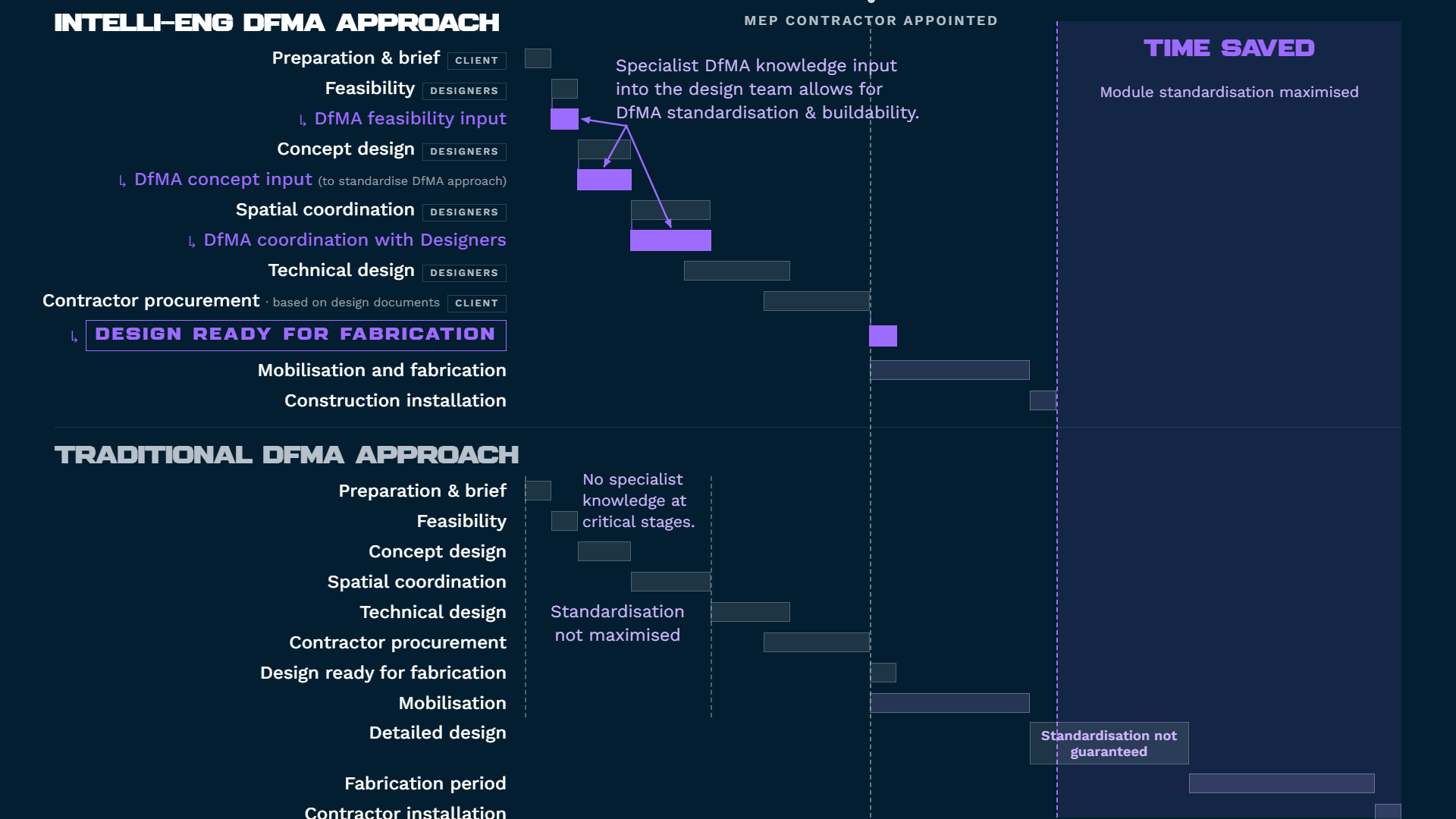
The greatest programme gains from DfMA are achieved when standardisation and buildability decisions are made during feasibility, concept design and spatial coordination. By embedding practical DfMA expertise before contractor procurement, key decisions are resolved earlier, reducing redesign, accelerating manufacture and shortening the overall construction programme. The comparison below illustrates how early DfMA engagement brings forward critical design decisions, allowing manufacturing readiness to be achieved earlier and reducing overall programme duration.
Why early DfMA engagement delivers better outcomes
Early engagement approach
Practical DfMA knowledge embedded into design team
Specialist knowledge enables decision making that maximises standardisation at early stage
Spatial coordination carried out with clear DfMA strategy in mind
Procurement with ready-made standardised DfMA, enabling a faster route to manufacturing
Prescribed approach to contractor ensures time saved with feasibility, strategy and coordination
Contractor pricing remains competitive – as DfMA strategy ready to procure
Traditional
Specialist knowledge not available at feasibility & concept stage
Early engagement prices are usually costly, therefore contractor not involved
If contractor is involved before procurement, a premium is usually added once available for tender due familiarity with the project
Feasibility carried out at tender stages when design decisions have already been carried out, limiting DfMA
Mobilisation of DfMA Engineers & BIM takes time, with further effort required to analyse the constraints of the project in order to maximise DfMA
DfMA benefits usually oversold as part of the bidding process
DfMA buildability issues in base model cause more time to release for manufacture.
DfMA delivers its greatest value when it is treated as a design strategy rather than a manufacturing exercise. The earlier buildability and standardisation decisions are made, the greater the programme advantage.
the measurable benefits of early Dfma planning
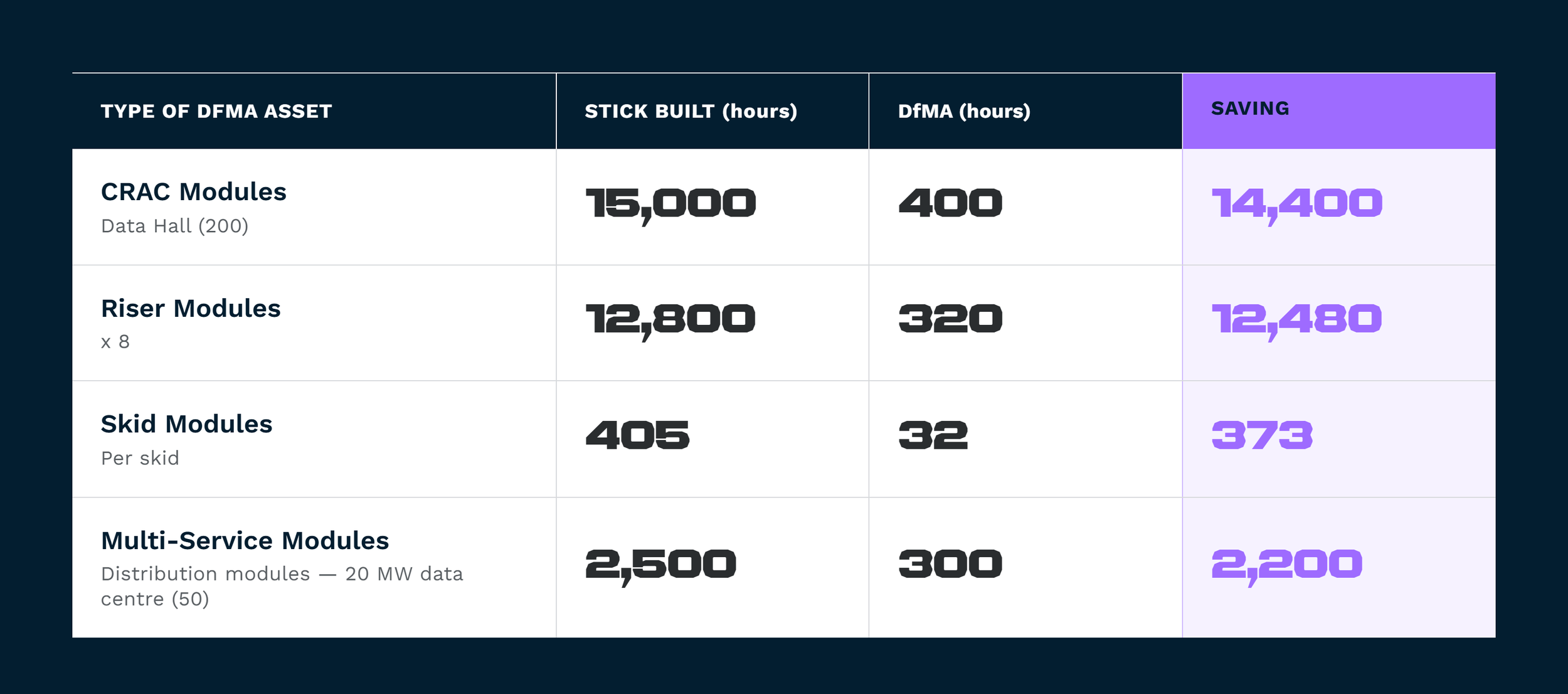
The greatest benefit of DfMA is not simply off-site manufacture, it’s the reduction in site labour and project duration that standardisation makes possible. As data centres move to increasingly remote locations and skilled labour becomes harder to secure, reducing on-site installation hours has become a significant commercial advantage. The comparison below illustrates the difference between traditional stick-built MEP installation and a standardised DfMA approach on a 20MW data centre.
Reduced site labour is only part of the benefit. When DfMA is standardised and repeatable, significant time can also be removed from the engineering and BIM process before manufacture begins.
A standardised DfMA strategy embedded early in the procurement process can deliver significant programme and cost benefits. When practical delivery knowledge is introduced at the earliest design stages, spatial coordination can be developed around a standardised approach that: (a) maximises repetition, a critical factor in unlocking manufacturing efficiency and speed; and (b) significantly reduces BIM coordination hours for both designers and contractors during project delivery, saving BIM detailing hours as well as detailing time and costs. The example below illustrates the BIM time savings achieved on a 20MW data centre.
29,453 hours moved to offsite through early engagement
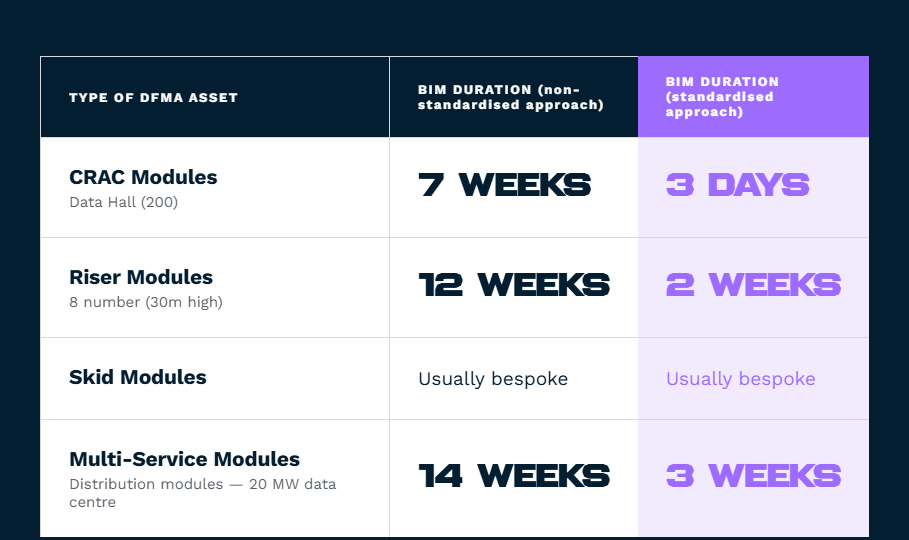
Together, these labour and design efficiencies demonstrate that the greatest DfMA gains are achieved through standardisation. The more repeatable the solution, the greater the reduction in both site installation effort and programme duration.
saving 28 weeks of bim detailing through standardisation
What 20 years of UK data centre DfMA has taught us
Embedding specialist knowledge to ensure a practical scheme can be produced at the feasibility and concept stage is the key to unlocking speed and certainty. Too many projects are missing clear opportunities to build at speed via a prolonged approach to detailed design.
Integrating expert Design for Manufacture and Assembly (DfMA) knowledge early into the initial design phase, rather than waiting for contractor procurement, is essential for data centre projects to maximize standardization, compress BIM coordination schedules, and significantly reduce on-site construction hours
Intelli-Eng has spent over two decades delivering MEP DfMA in the UK and we’re now deploying that experience mainland Europe through our Mainz engineering hub. Our unique inception to completion experience includes:
Full DfMA concept proposal
Presentation of strategy to stakeholders
Standardisation proposals to reduce BIM hours & Drawing times
Module mapping
Specialist procurement
Fabrication detailing
Logistics & Lift planning
Interface management
Factory liaison and production scheduling
Installation methodology and execution
QAQC & Handovers
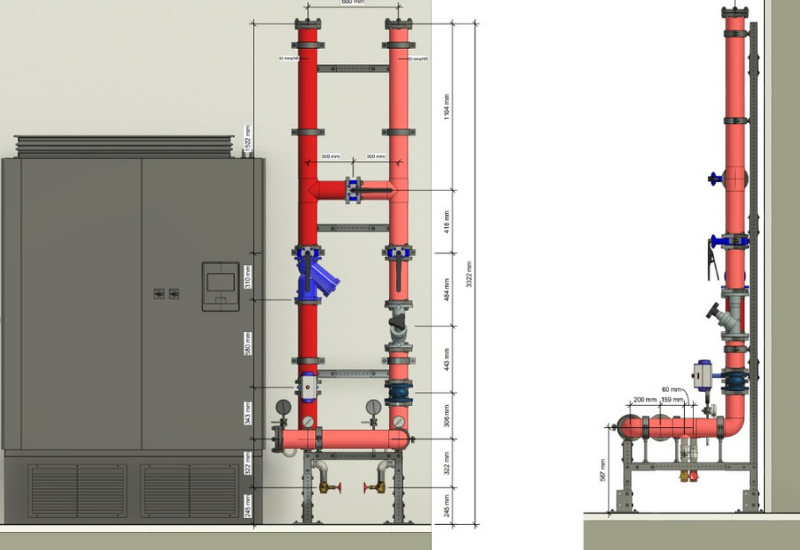
Case Study: Standardised CRAC Unit Module
On a recent European project, through early DfMA standardisation approach, a single module design was repeated 120 times. A BIM asset created by the Intelli-Eng team was delivered, QA’d and agreed by the client whom then utilised the group set as part of their base design. This enabled CRAC 120 modules to be manufactured from just one drawing.
This was achieved by working closely with the design team to provide subtle buildability recommendations on a base design through feasibility studies. Thus maximising repeatability and simplifying
Case Study: MEP Shaft Construction
Location: Chelsea Barracks (United Kingdom)
16 out of 18 riser shafts were designed for manufacture and assembly. All risers were 30-35m high and consisted of five modules installed one on top of the other via a specialist locating pin. Each riser was delivered from the factory and lifted into position within a day.
Riser modules supported from the basement level
Entire riser lifted and installed within a day
Incorporation of GRP flooring meant able to access immediately after lift
All services included only connections required after installation
No scaffold within riser shaft required
Result: 8 weeks vs 8 Hours on site installation